

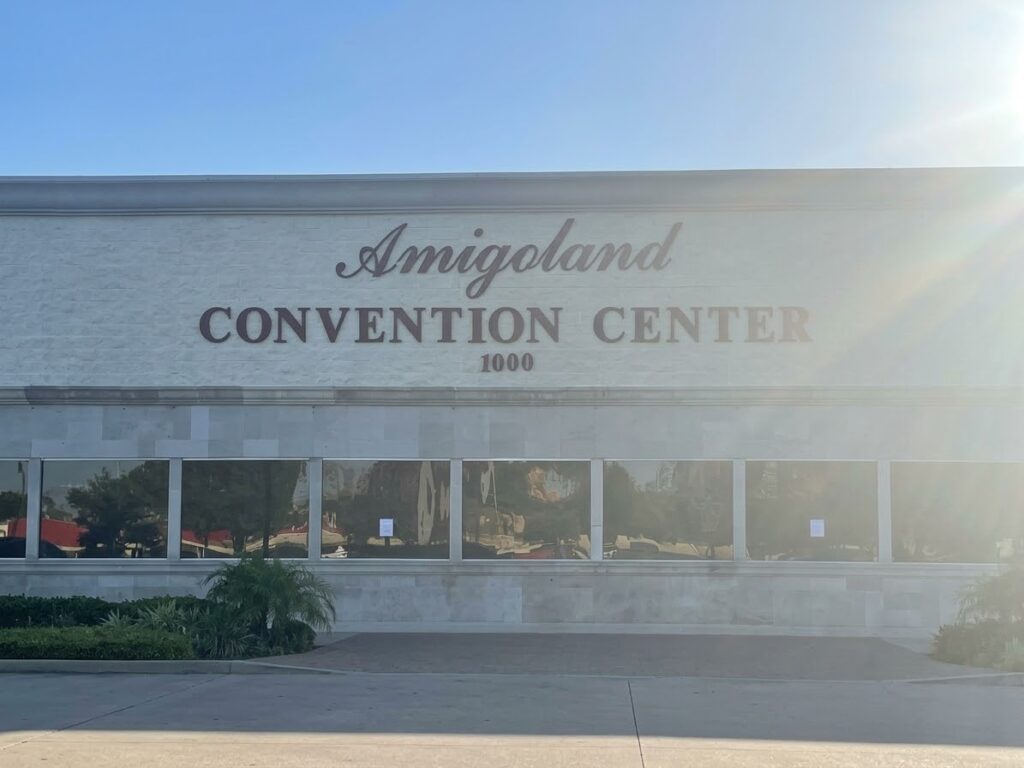
The Amigoland Convention Center in Brownsville served as a recruitment site for proposed data center. Miguel Vazquez | Vaquero Radio
Data centers in the RGV could create jobs and bring new investments to the region but also uncertainty about their limited job opportunities and demand for natural resources raise concerns about their long-term benefits.
UTRGV Economics Professor Xi Mao said companies may find the RGV attractive because of its affordable land, lower population density and access to wind energy.
“First of all, our land is relatively cheaper,” Mao said.
Mao said data centers require powerful computer systems to store and process information. Although construction could create temporary jobs, these facilities may employ relatively few permanent workers.
She said data centers could offer positions in information technology, engineering, security and general maintenance.
Mao also said the facilities could generate revenue through property taxes and utility payments. However, tax incentives could affect how much revenue local governments collect.
Beyond economic benefits, Mao raised concerns about the environmental impact of data centers.
She said the facilities could increase water and electricity demand while creating noise and light pollution for nearby communities.
Mao said water-saving technology could reduce some environmental concerns, but those systems may increase operation costs.
Despite those challenges, Mao said data centers could provide career opportunities for UTRGV students majoring in engineering and technology.
She emphasized that economic development does not always benefit every resident equally.
Mao said officials should consider both the economic advantages and the potential effects on surrounding communities before moving forward with these projects.
When asked whether data centers would be a good long-term investment for the region. Mao said their overall impact remains uncertain.
“[Did] we make a good decision? or bad decision?.” Mao said “Things [are] getting changed, you never know.”
South Texas Environment Justice Network Disaster Recovery Coordinator Valeria Caballero said large artificial intelligence data centers require significant amounts of water and electricity to operate.
Caballero said the facilities use water to cool powerful computer systems, raising concerns about their impact on a region already facing drought conditions.
She also warned that the facilities could increase air pollution if companies rely on natural gas generators or power plants to meet their electricity needs.
Caballero said the projects could threaten wildlife habitats and undeveloped land near Boca Chica Beach and the Port of Brownsville.
Beyond environmental concerns, Caballero questioned whether data centers would provide enough permanent jobs to benefit local families.
“It’s not really serving most of the community, it’s actually just taking from it ,” Caballero said.
Caballero said construction could create temporary employment, but the facilities would offer fewer opportunities once operations begin.
She also addressed Brownsville’s 90-day pause on data center development, saying the city should extend it to the maximum 180 days allowed under Texas law.
Caballero said officials created an environmental task force to study the potential effects on water, electricity and surrounding neighborhoods.
She said the task force will gather community input and recommended protections for residents.
Caballero, who serves as chair of the task force, encouraged residents and UTRGV students to participates in public meetings and contact local offices.
“We all have a part to play and I think its within our capacity to send that email or to go that public meeting,” Caballero said
Vaquero radio contacted the City of Brownsville Boards and Commissions and the Brownsville Chamber of Commerce Board of Directors but did not receive a response as of the airing of this broadcast.
This is Miguel Vazquez for Vaquero Radio.