
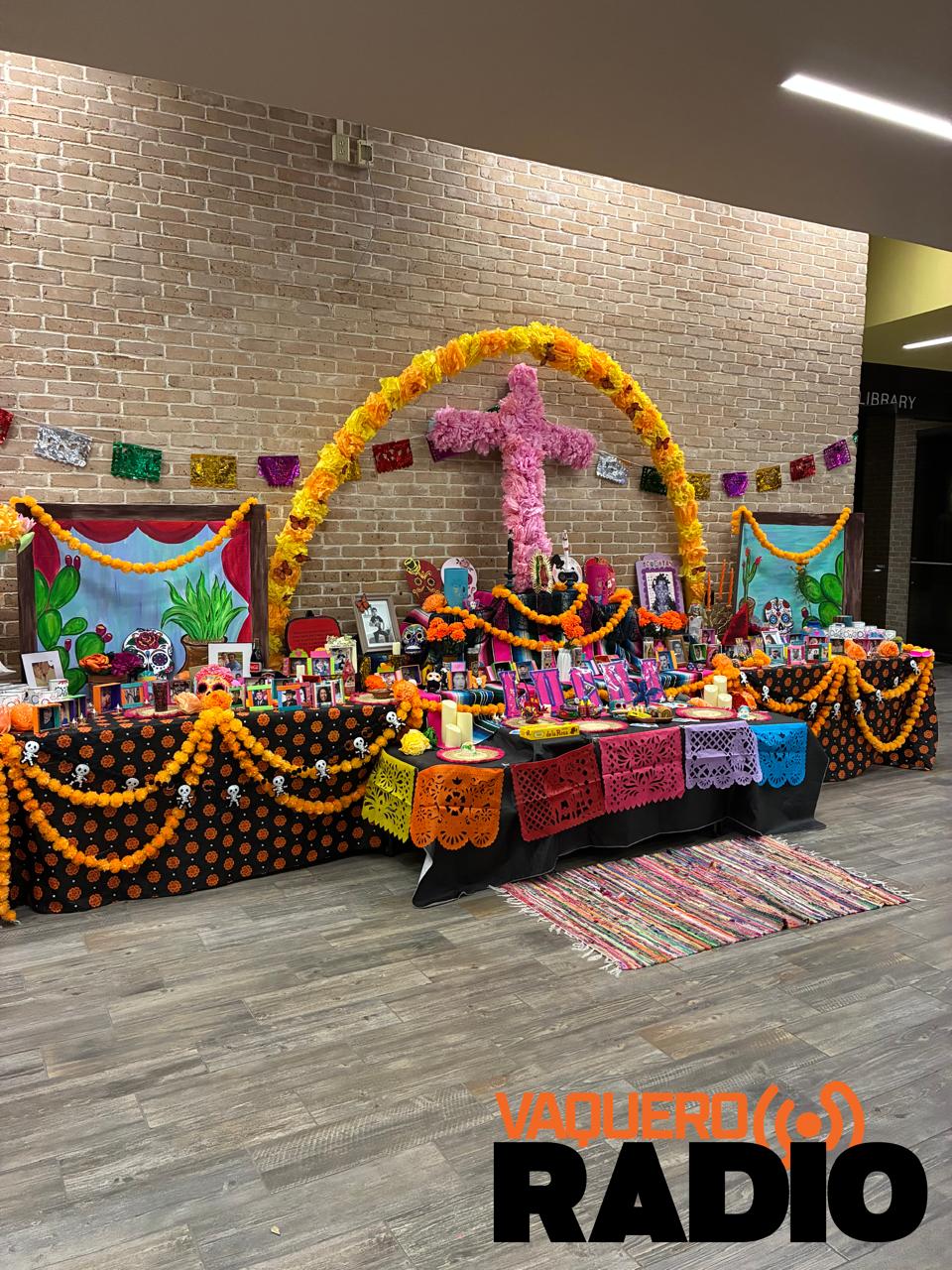
An ofrenda on display in the library lobby on UTRGV's Edinburg campus Diego Montano/Vaquero Radio
For generations, Día de los Muertos has brought Mexican families together to honor loved ones who have passed away, turning remembrance into a celebration of life.
Observed primarily on Nov. 1 and 2, the tradition developed through centuries of interaction between Indigenous Mexican practices honoring the dead and Catholic observances introduced during Spanish colonization.
Today, families create ofrendas, or altares, decorated with photographs, candles, marigolds and the favorite foods of those they remember.
In the Rio Grande Valley, where Mexican culture extends across generations and both sides of the border, Día de los Muertos continues to serve as a connection to family history and cultural identity.
At UTRGV, the student organization La Unión Chicana de Hijxs de Aztlán, known as LUCHA, brought that tradition to campus through a community ofrenda at the Edinburg Library Lobby.
LUCHA Vice President Diego Alberto Vigil said the celebration encourages students to reflect on their cultural roots.
“Especially during our convivio, we hold a moment of silence to think about everybody who has passed, and just having a moment to understand and reflect that it’s not always the worst part of life. It is a celebration of [the] completion of a life,” Vigil Alas said.
The altar allowed students to contribute photographs and personal memories, transforming a tradition often observed within families into a shared experience on campus.
LUCHA also hosted a cultural forum with the Universidad Tecnológica de Matamoros, bringing perspectives from both sides of the border to discuss the celebration’s history and meaning.
Although Día de los Muertos originated in its present form in Mexico, the tradition has continued evolving among Mexican American communities, where students may experience its customs differently from previous generations.
LUCHA Treasurer Daphne Escamilla described how the organization’s convivio brought students together through traditional activities, including lotería and folklórico dancing.
“Essentially, it’s just hanging out, sharing ideas, sharing our beliefs, remembering the dead, those who have passed away, and we want to remember dearly,” Escamilla said.
Beyond its colorful decorations, the celebration reflects a tradition of passing memories and cultural practices from one generation to another.
For students in the Rio Grande Valley, the ofrenda represents more than a display. It provides an opportunity to connect with their Mexican heritage while sharing personal stories of remembrance with the university community.
Vigil said he hopes students who visit the ofrenda recognize the value of the memories and experiences passed down through their families.
“Through their memories and their shared collective experiences, they leave something behind, something that you can’t get monetarily. You can’t buy or seek out,” Vigil Alas said.
For more information about the history and traditions of Día de los Muertos, visit the Smithsonian’s National Museum of the American Latino website at latino.si.edu.
This is Diego Montano for Vaquero Radio.